
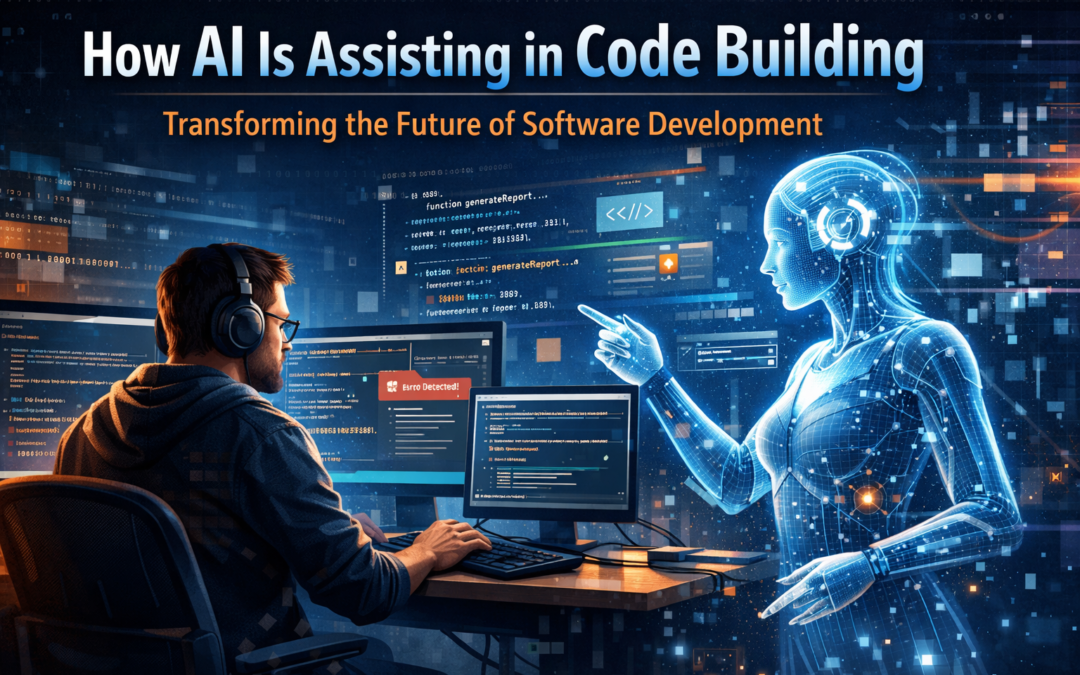
Artificial intelligence has moved far beyond theory and research labs—it’s now a practical, everyday tool in modern software development. From writing boilerplate code to identifying bugs before they reach production, AI is actively assisting developers at every stage of the coding lifecycle. Rather than replacing engineers, AI is amplifying their capabilities, accelerating delivery, and raising the overall quality of software.
The Shift From Manual Coding to Assisted Development
Traditionally, software development has been a deeply manual process: writing repetitive logic, searching documentation, debugging line by line, and refactoring legacy code by hand. AI-assisted coding introduces a new paradigm—augmented development—where developers collaborate with intelligent systems that understand context, patterns, and intent.
Instead of starting from a blank file, developers can now work from AI-generated scaffolding, suggestions, and real-time feedback.


1. AI-Powered Code Generation
One of the most visible impacts of AI in development is automated code generation. AI models trained on vast amounts of open-source and proprietary code can:
- Generate functions, classes, and components from natural language prompts
- Produce boilerplate for frameworks, APIs, and configuration files
- Translate logic between programming languages
- Suggest implementation details based on surrounding code context
This dramatically reduces time spent on repetitive tasks and allows developers to focus on architecture, business logic, and problem-solving rather than syntax.
Result: Faster development cycles and fewer context switches.
2. Smarter Debugging and Error Detection
Debugging has historically been one of the most time-consuming parts of development. AI-assisted tools now help by:
- Identifying likely causes of runtime and compile-time errors
- Suggesting fixes directly in the editor
- Detecting edge cases and null conditions
- Highlighting potential performance bottlenecks
Some systems go further by analyzing patterns across large codebases to predict where bugs are most likely to occur—before the code even runs.
Result: Fewer bugs reach production and less time is spent firefighting.
3. Code Review and Quality Enforcement
AI is increasingly used as a first-pass code reviewer. These systems can:
- Enforce style guides and best practices
- Flag security vulnerabilities (e.g., injection risks, unsafe dependencies)
- Identify duplicated logic or inefficient algorithms
- Recommend refactoring opportunities
While human review remains critical for architectural and business decisions, AI dramatically improves consistency and reduces review fatigue.
Result: Cleaner, more maintainable codebases at scale.
4. Accelerated Learning for Developers
AI tools act as real-time mentors—especially valuable for junior developers or engineers working in unfamiliar stacks. Instead of searching through documentation or forums, developers can:
- Ask for explanations of existing code
- Get examples of how to use specific APIs or frameworks
- Understand why a particular approach is recommended
- Learn idiomatic patterns for a language or ecosystem
This lowers onboarding time and makes teams more adaptable.
Result: Faster ramp-up and broader skill coverage across teams.
5. Bridging the Gap Between Ideas and Implementation
One of AI’s most powerful roles is translating intent into code. Product managers, designers, and non-technical stakeholders can describe functionality in plain language, which developers can then refine with AI-generated starting points.
This tightens the feedback loop between concept and execution and reduces misinterpretation of requirements.
Result: Better alignment between business goals and technical implementation.
6. What AI Does Not Replace
Despite its capabilities, AI does not replace core engineering judgment. It cannot:
- Fully understand business context or user nuance
- Make architectural tradeoffs with long-term ownership in mind
- Take responsibility for production failures
- Replace creativity, intuition, or domain expertise
AI excels as an assistant, not an autonomous engineer.
The Future of AI-Assisted Coding
As AI models improve, we can expect deeper integration into development workflows:
- End-to-end feature scaffolding tied to requirements
- Continuous code optimization in CI/CD pipelines
- AI-driven test generation and coverage analysis
- More personalized coding assistants that learn team conventions
The role of the developer is evolving—from writing every line of code to orchestrating systems, validating outcomes, and solving higher-order problems.
Final Thoughts
AI is not changing whether code is written—it’s changing how it’s written. By handling repetitive, error-prone, and time-consuming tasks, AI frees developers to focus on what matters most: building reliable, scalable, and meaningful software.
In the coming years, the most effective teams won’t be those that avoid AI—but those that learn how to use it strategically.